The filtered system uses screens, cloth, foam, or paper to clean the air coming in. The air passes through the filtration layer, and any dirt and debris is left behind in the receptacle. What is a central vacuum system?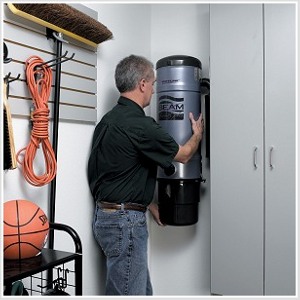
A central vacuum system lets you clean rooms without carrying around a portable vacuum. You take a hose and brush head from room to room, hook it up to a special inlet in the wall, and vacuum.
Plastic tubing runs through the walls and connects to a central unit receptacle where dust and debris are stored. These central units can be located in out-of-the-way places like a garage, basement, or storage room. You choose the location to install it.
You also can choose how you want to install the plastic tubing that carries dirt and debris to the centralized receptacle.
And you choose the location of the wall inlets where the vacuum head and hose hooks up. The amount of inlets you install depends on the square footage of your rooms. Usually, there is one hookup for every 600 square feet.
Once the whole system is installed, you’re ready to vacuum. Plug the hose and power brush into a wall inlet, and turn on the vacuum (the on button is usually located on the brush handle). You don’t have to go to the central system to turn it on. It’s always on standby, waiting for you to turn on the vacuum via the brush handle.
Now that the whole system is on, you vacuum the room. Dirt gets sucked into the hose and travels through the tubes in the walls to the central receptacle.
Maintenance of the central vacuum system requires you to empty the central receptacle of debris on average every three months. If your system uses a filter, you’ll want to clean that when you empty the receptacle.
There are two different kinds of central vacuum systems to choose from. The “cyclonic” and the “filtered” systems. Ask your cleaning service which option best fits your needs.
The filtered system uses screens, cloth, foam, or paper to clean the air coming in. The air passes through the filtration layer, and any dirt and debris is left behind in the receptacle.
The cyclonic system uses centrifugal (twister-like) force to separate impurities from the incoming air. Because of the centrifugal force imposed on incoming air from the tubing system, all dirt and debris remain spinning in the center of the system as the air separates from it.
Installing a central vacuum system generally costs $1000. That includes the installation of the central receptacle unit, the power unit, the plastic tubing, and the attachments—such as the brush and hose.
Here are some central vacuum system terms to keep in mind when working with your cleaning service:
AMPS—the electricity required to operate the system.
CFM—“cubic feet of air per minute,” the maximum airflow possible while the vacuum is operating.
HEPA—“high efficiency particle arrestor,” the special filter used to reduce airborne dirt from vacuuming.
Who should install a central vacuum system?
Those with large homes can testify that vacuuming is an often insurmountable-seeming challenge. With possibly thousands of square footage, lugging around a portable vacuum is a dreaded chore.
Others don’t have the time to carry a cumbersome vacuum from room to room, or the money to hire a cleaning service. With a central vacuum system, heads and hoses can be kept in a convenient location. You could even have more than one set, maybe if you have multiple floors in your house.
For those interested in the latest in home cleaning systems, the central vacuuming system is especially attractive because of its revolutionary convenience.
What are the benefits and drawbacks to installing a central vacuum system?
Unfortunately, the central vacuum system can cost about $1000 to install.
Even though you don’t have to carry around a heavy vacuum cleaner from room to room in search of a well positioned electrical outlet, you still have to carry the brush head and hose from room to room. It’s efficient and convenient, but it’s certainly not hands-off and automatic.
But, of course, with the central vacuuming system, there’s no need to search for outlets, and you’re never limited by the length of a vacuum’s power cord, especially since the central vacuum system’s hoses are commonly 25 feet long.
And normal portable vacuums end up blowing some dirt back into the room. The central vacuum system takes care of all the dirt, because it goes straight into the wall inlet and through the tubing system. This results in healthier air.
Because the motor for the system is remote, there’s less noise than using a portable vacuum.
Good portable vacuums have become increasingly expensive. Central vacuum systems may actually cost less than a new portable vacuum, and they can add $2000 to your home’s resale value.
Finally, a central vacuum system can help prolong the life of carpets, upholstery, drapes, and furniture because it is much more powerful than many portable vacuums, and can clean more thoroughly.
The bottom line with central vacuum systems
A central vacuum system may be the perfect thing for you. If you value higher cleaning efficiency, the newest cleaning products, and cleaner air in your home, you’ll want to call a cleaning system that can install this amenity.
But if you think carrying around the hose and brush head is a chore similar to carrying a portable vacuum, then you might not benefit so much from installing a central vacuum system. The most up-to-date in domestic convenience isn’t always so convenient for everyone.
If you are considering vacuum systems, check out the following links to find specialists in your area:
Atlanta General Contractor | Boston General Contractor | Charlotte General Contractor | Chicago General Contractor | Dallas General Contractor | Los Angeles General Contractor | Miami General Contractor | Minneapolis General Contractor | New York General Contractor | Philadelphia General Contractor | Phoenix General Contractor | San Francisco General Contractor | Seattle General Contractor | Washington, DC General Contractor | See More Cities




You can also find a central vacuum cleaner dealer who installs cyclonic central vacuum cleaner at http://dealer.centralvachq.com/dealer.aspx?vac=2
Product Specialist – August 10, 2009 , 6:28 PM